

Teaching professionals can lose between eleven and thirteen hours each week marking assignments and exams.1 Digital grading can help reclaim this time back by automating the marking process.2
Summatic's online mark book and detailed performance analytics assure less time is spent marking so more time can be focused on teaching and research. Drawing on our platform's features and instructor feedback, we identify five ways in which digital grading can upgrade your course.
1. Faster Results and Scalability
When you are evaluating answers from hundreds of students, the marking process of just one exam alone can seem daunting. For courses assigning weekly exams, quizzes, or exercises, grading time can quickly compound and obstruct time that could be used for lesson planning or prep.
Digital grading is empirically proven to reduce grading time from a minimum of 25% up to 50% for both larger courses with multiple instructors and smaller courses with single graders.3
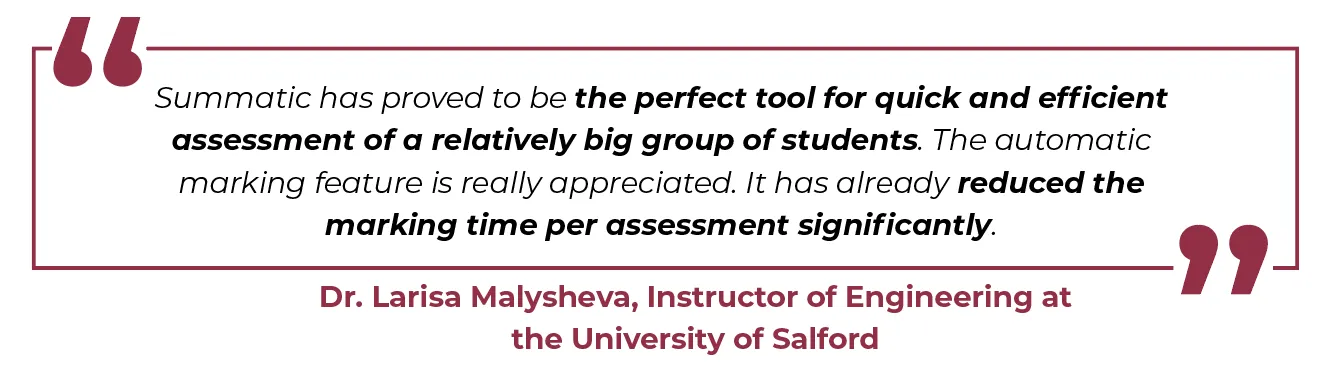
Automated marking not only provides faster results but flexible benefits of scalability.4 Instructors using Summatic often emphasize their appreciation for our automatic marking, particularly in assessing and evaluating large groups of students. Supporting the School of Engineering at the University of Salford, our platform received the following feedback from lecturer Dr. Larisa Malysheva:
2. Reliable and Equitable Evaluations
Backed by our symbolic algebra engine, our automated grading has a proven reliability rate of >99.9%. Our software accurately evaluates steps of work and the full range of notation by allowing students to answer in different forms, e.g., long-form, matrices, graphical, etc.
Our digital mark book furthermore ensures equitable evaluation. Our grading system provides impartial reviews that eliminate any risk of human error or bias to provide fair and neutral evaluations.5
3. Instant Feedback for Students
Results are delivered instantly with step-by-step feedback to walk students through each question and guide them towards correct answers by allowing them to view fully worked solutions and linked learning resources for comprehensive explanations.
Providing students with instant feedback eliminates the delay caused by the conventional hand marking process, establishing immediate connections between wrong answers and a correct explanations, which have been shown to assist with retention and integration.6
4. Streamlined Performance Analytics
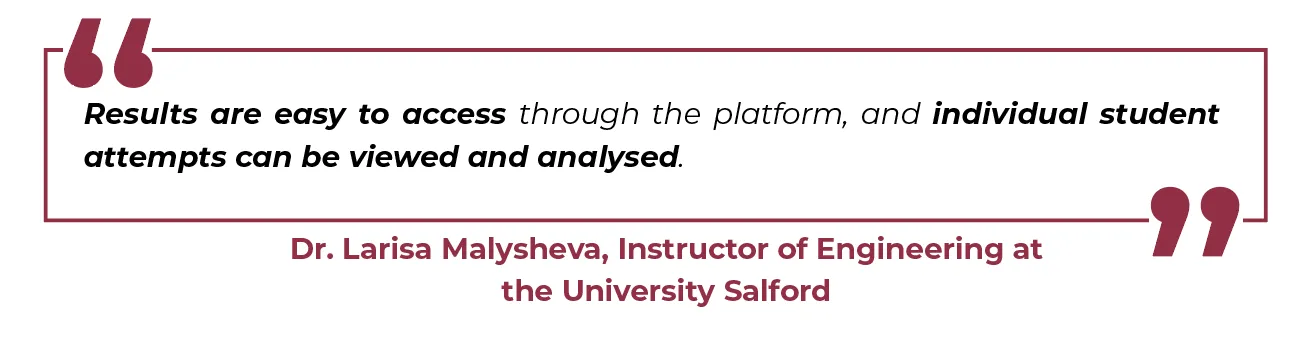
Tracking student progress has never been simpler than with the use of our digital mark book and performance analytics. Summatic presents a real time overview of student scores, attempts, and improvement. The mark book provides clear insights on common mistakes, levels of engagement, and score progression among students.
Our mark book, shown below, breaks down responses on assignments and exams with reports reflecting question-by-question performance of each student:
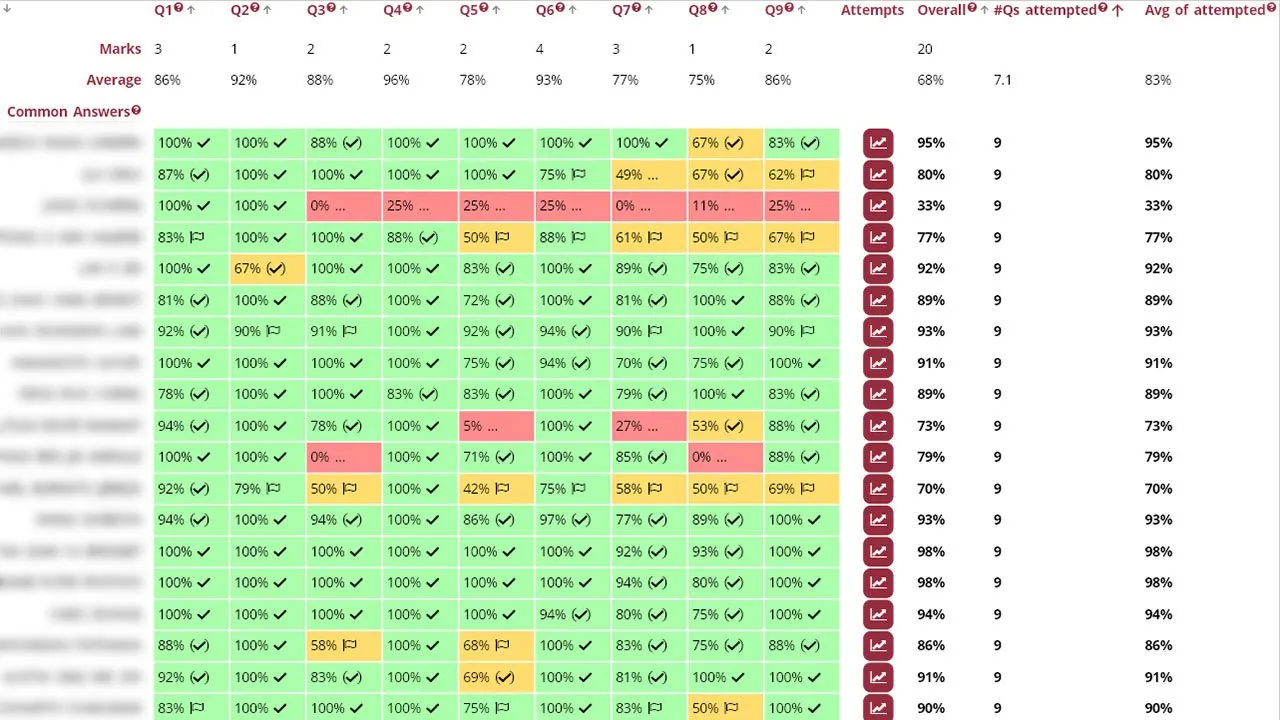
Rows indicate the performance of each student, and columns indicate their performance on each question. Results are tallied on the right-hand side to provide overall engagement and performance. Instructors can also download additional analytics, including metrics on average question attempts per student, average assignment result per student, and an overall histogram of scores.
5. Identifiable Learning Gaps
Our colour-coded mark book and summary statistics make questions or topics students are struggling to grasp easily identifiable. This enables instructors to quickly recognize and address learning gaps in student cohorts to effectively target those areas of weakness.
As Summatic's automated mark book allows instructors to review student attempts question-by-question, this level of granularity allows for a close evaluation of each student's approach:

For those questions without random variants, instructors also receive an overview of 'common attempts,' which can again be illustrative of common mistakes for what concepts students are struggling to grasp:
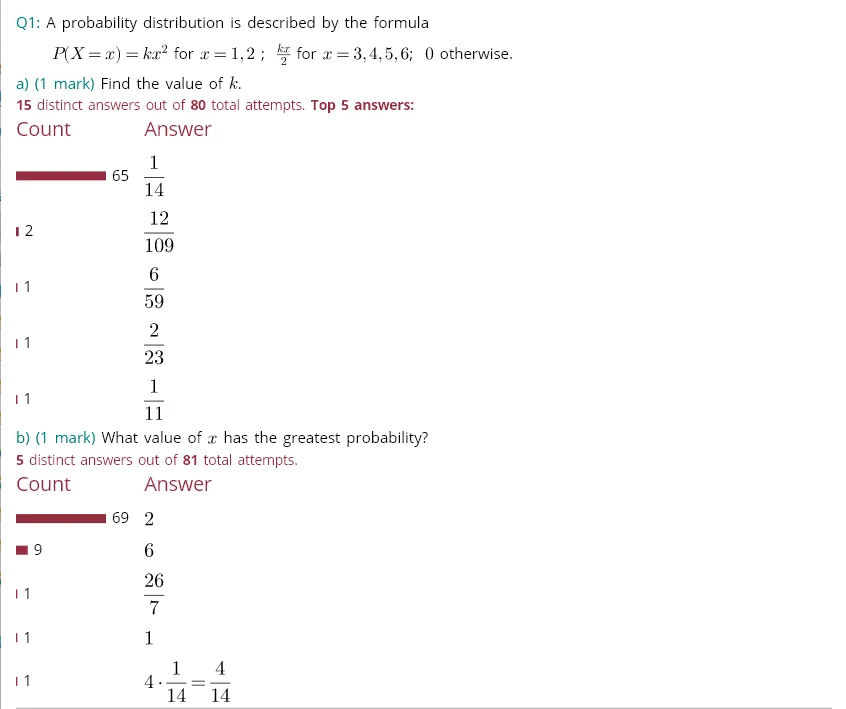
The ‘Sankey Diagram’ can also be downloaded from the mark book to depict how student score improvement is progressing from one variant to another. This diagram can be illustrative for instructors to assess whether students are mastering topics with practice or whether more revision is needed:
Reclaim Your Schedule and Upgrade Today
If you are feeling overburdened with the marking process and want to reclaim time back into your schedule, you should consider the use of digital grading in your course.
Speak with a member of our team through our live web chat to discover how Summatic can quickly transform your course into an online learning experience that provides you and your students with instant results, step-by-step feedback, and performance analytics — granting you more time, flexibility, and command to prepare lessons and engage with students inside the classroom.
-
QA Education. UK Teachers Spend a Whole Day on Marking Each Week, https://qaeducation.co.uk/feature/uk-teachers-spend-whole-day-marking-each-week/.↩
-
Bryant, Jake, Heitz, Christine, Sanghvi, Saurabh, and Wagle, Dilip (2020) How Artificial Intelligence Will Impact K-12 Teachers, McKinsey & Company, https://www.mckinsey.com/industries/education/our-insights/how-artificial-intelligence-will-impact-k-12-teachers.↩
-
Bloomfield, Aaron (2010) Evolution of a Digital Paper Exam Grading System, Frontiers in Education Conference, Session T1G, https://www.cs.virginia.edu/~asb/docs/fie-2010.pdf.↩
-
The Princeton Review (2024) The Evolution of Education: How AI is Reshaping Grading, https://www.princetonreview.com/ai-education/how-ai-is-reshaping-grading.↩
-
Ibid. Kelly, Kevin, & Zakrajsek, Todd D. (2020) Advancing Online Teaching: Creating Equity-Based Digital Learning Environments, Routledge; 1st Ed., print.↩
-
MIT Teaching + Learning Lab (2024) Help Students Retain, Organize and Integrate Knowledge, https://tll.mit.edu/teaching-resources/how-to-teach/help-students-retain-organize-and-integrate-knowledge/.↩