

Authenticity Matters
Being able to set up and solve quantitative problems are core skills taught in Microeconomics. Unfortunately, these types of problems do not translate well to the multiple-choice format questions (MCQ) that tend to dominate digital assessment on leading learning management systems such as Blackboard, Canvas and Moodle.
It is well known that relying on MCQs to assess quantitative subjects involves a loss of authenticity and a risk that key skills are not being assessed.1 Students are encouraged to guess and trying to game an inflexible assessment format rather than maximizing relevant learning outcomes.
While online platforms have been extensively used for introductory Economics courses since the early 2000s,2 their lack of authenticity still limits their use in more quantitative courses such as Intermediate Microeconomics.
A Platform for Assessing Microeconomics
At Summatic we are using technology to improve the experience of learning, teaching and assessing Microeconomics. The goal is to preserve authenticity and technical rigour while at the same time making use of the opportunities that the digital format offers to improve engagement, accelerate learning and simplify assessment.
Our online platform allows for a wide variety of inputs, including graphs, equations and formulas, and can authentically replicate most relevant pen and paper problems. For assessment our extensive question bank can be used for diagnostic tests, assignments, exams, alongside independent learning, with student attempts being automatically and reliably marked.
Below we illustrate Summatic's approach to making Intermediate Microeconomics authentic, using a competitive equilibrium and an indifference curve as examples.
Example 1: Finding a Competitive Equilibrium
Finding a competitive equilibrium is an example of a type of problem that does not naturally lend itself to using MCQs. These problems are quantitative by nature, and typically involve working through a number of steps using a variety of inputs.
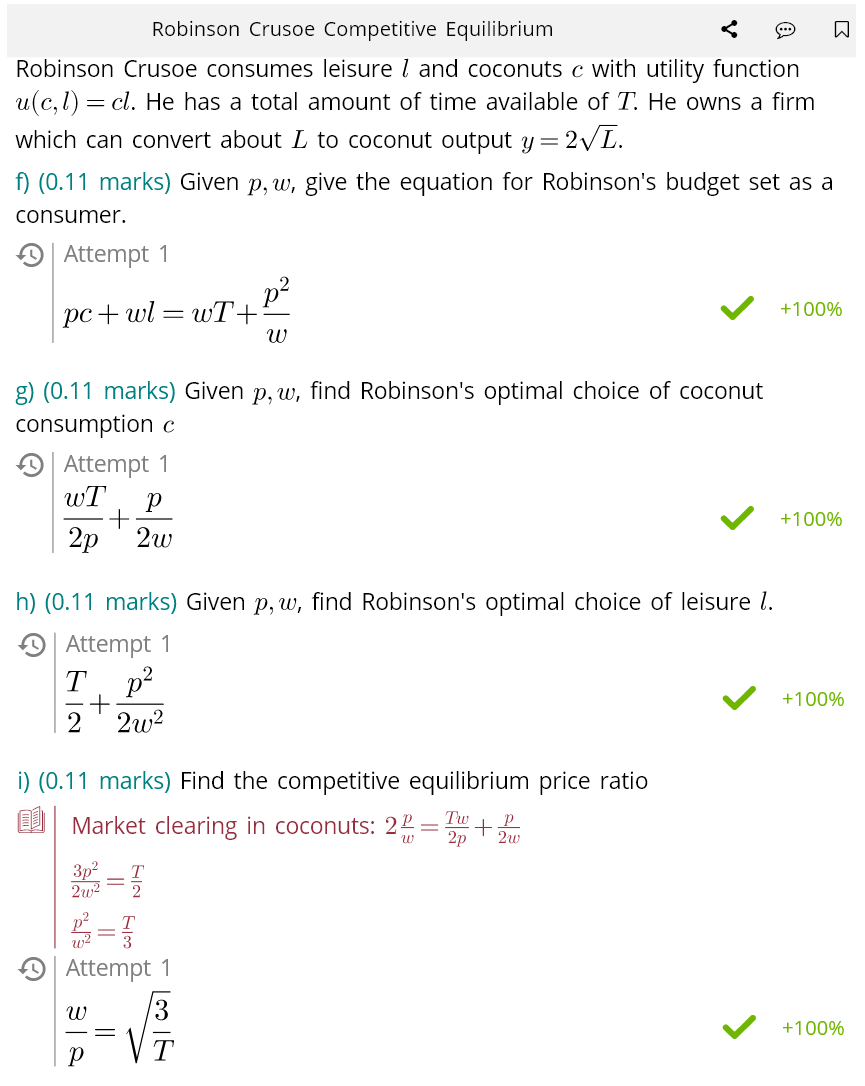
In the example above, students have to solve for a competitive equilibrium in a Robinson Crusoe style of economy. A traditional pen and paper version of this problem would involve different parts with functions and equations as inputs.
As can be seen, this is also true on Summatic. Students are amongst other things asked to express profits as a function of goods prices and wages, write down the equation for Robinson's budget constraint and solve for the competitive equilibrium price ratio, with answers being automatically and reliably marked.
Example 2: Sketching Graphs – Indifference Curves
Sketching and manipulating graphs are also core skills taught in Microeconomics, and Summatic allows you to both practice and test these skills online with answers being automatically and reliably marked. In the example below, students are asked to sketch an indifference curve.
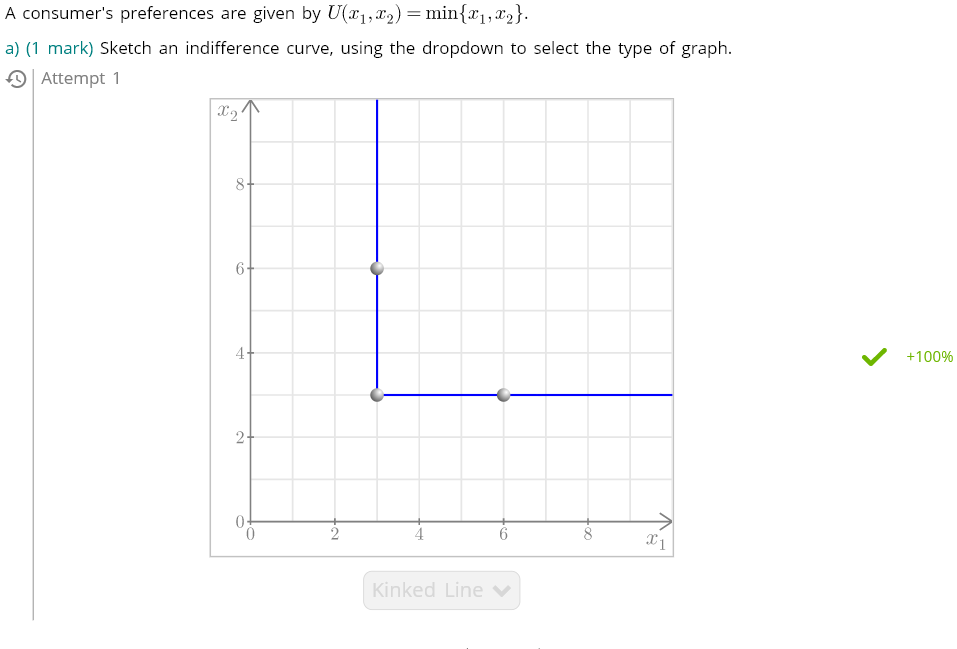
By using the dropdown menu below the graph, they can select the type of curve they want to draw and then manipulate it in the graph before submitting their answer. Here, the agent has a Leontief type of utility function resulting in “L-shaped” indifference curve.
Benefits of Digital Assessment
Automatic marking is an important advantage of digital assessment. It supports both teachers and learners. Lecturers and teaching assistants save time marking and are able to easily track student progress on the individual as well as group level using automatically generated analytics. Students on the other hand get instant feedback on their work.
In addition, digital assessment is flexible, can be individualized and allows for randomized question variants, which in turn allow for unlimited practice. Together, instant feedback and unlimited practice improve engagement, learning and make it possible for all students to get to a point of getting a method correct independently, even when it is difficult.
-
Aplia was introduced in 2002. See for instance Collins, D., Deck, A. & McCrickard, M. (2008). ‘Computer Aided Instruction: A Study Of Student Evaluations And Academic Performance’. Journal of College Teaching & Learning, 5(11), 49-57. https://core.ac.uk/download/pdf/268110541.pdf.↩